
Riprap Med Delivery in Austin, TX
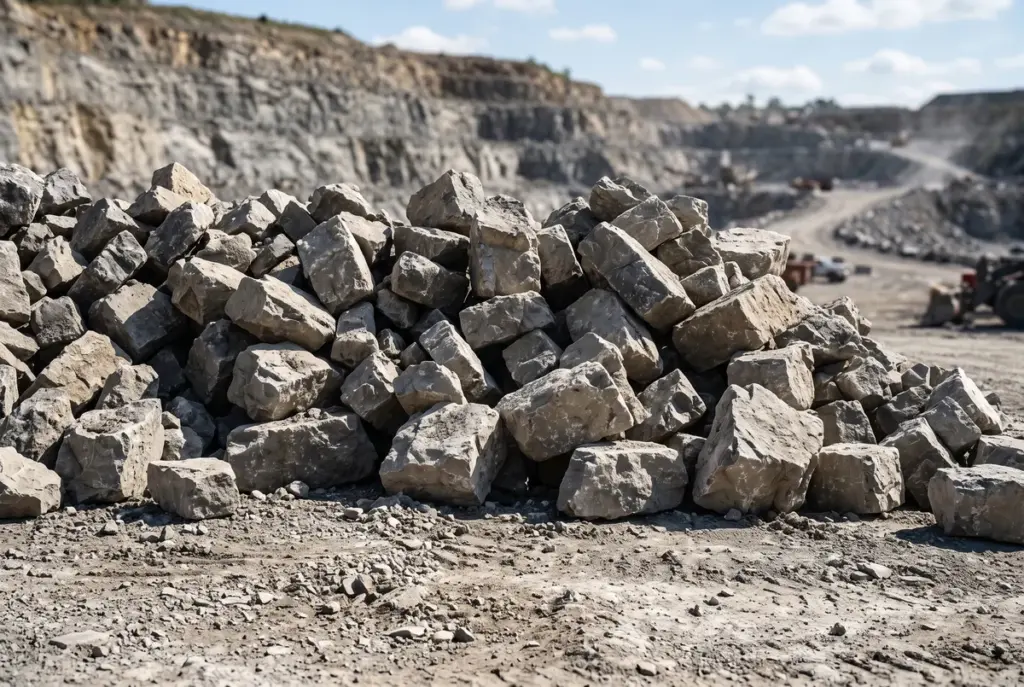
Bulk riprap med delivered in Austin, TX. Stone size 4 - 9. Gray color.
Bulk Riprap Med Delivery in Austin, TX
Austin sits squarely in Flash Flood Alley, the stretch of Central Texas where the Balcones Escarpment wrings sudden, violent rain out of Gulf moisture and dumps it into creeks that can go from a trickle to a torrent in under an hour. That hydrology defines local erosion work. Medium Riprap Med is the stone that holds banks, slopes, and outfalls together when Shoal Creek, Waller Creek, or Onion Creek decide to rise overnight. These are angular gray pieces graded from 4 to 9 inches that weigh roughly 2,700 pounds per cubic yard, heavy enough to lock down under fast water, yet still placeable by skid steer or by hand on smaller jobs. We deliver it across the Austin-Round Rock-Georgetown metro starting at just.
From a Hill Country lakefront on Lake Travis to a flood-scoured culvert outlet off MoPac to an eroding backyard slope in the limestone neighborhoods west of downtown, medium riprap is what Austin contractors reach for when moving water has to be tamed.
Why Austinites Use Medium Riprap
The ground around Austin is unusual. Thin clay soils sit over fractured limestone, so when heavy rain hits, the water sheets off fast instead of soaking in, and that runoff cuts banks and channels with surprising force. Medium riprap answers that pressure. Here is where it does the most work locally:
- Creek and channel bank armoring: Along the dozens of urban creeks that thread through Austin, a riprap revetment absorbs flow energy and stops the bank from undercutting during flash events.
- Slope and embankment protection: On the steep limestone grades of the western Hill Country neighborhoods, riprap holds cut slopes that would otherwise slough off in a gully-washer.
- Culvert and storm outfall outlets: Where a pipe dumps stormwater onto thin soil over rock, a riprap apron breaks the energy and prevents the scour hole that forms otherwise.
- Lakeshore and pond protection: Around Lake Travis, Lady Bird Lake, and the area's many stock ponds, riprap holds the waterline against wake and seasonal drawdown.
For lighter drainage work behind the armor, contractors often back medium riprap with Drain Rock and a filter layer. Where the look matters more than the load, a decorative dry creek bed in a Hill Country landscape might use River Rock instead, and on budget jobs Crushed Concrete sometimes serves as a base under the stone.
Local Delivery and Lead Times in Austin
We deliver riprap throughout the Austin metro, from central neighborhoods out to Round Rock, Cedar Park, Pflugerville, and down the corridor toward the Hill Country. Access drives the schedule here. A job with a clear driveway or a flat staging pad moves fast, while a tight downtown lot or a creekside drop with limited truck access takes more planning. Smaller orders around 5 tons typically arrive within 1 to 2 business days. Mid-size loads near 8 tons often go out same or next day. Full truckloads of 16 tons and up ship on our free-delivery tier.
Because Central Texas aggregate moves along the I-35 corridor, our routes also reach Round Rock (17 mi) just up the highway and San Antonio (74 mi) to the south, with Killeen (59 mi), College Station (88 mi), and Waco (95 mi) on the same regional network. That keeps stone flowing into Austin, but the I-35 crush is real, so give us as much lead time as you can during the spring building rush.
How Much Riprap You Need
Medium riprap is sold by the ton, and a good planning rule is that one ton covers about 35 to 40 square feet at a 12-inch placed thickness, the typical depth for creek bank and slope armor. Higher-energy creek faces call for a thicker layer and a wider stone gradation, so always round up.
Here is a quick coverage example. Say you are armoring a 50-foot stretch of eroding bank along a tributary behind an Austin property, and the sloped face you need to cover measures about 9 feet from toe to top, giving roughly 450 square feet. At a 12-inch placed depth that works out to around 11 to 13 tons. Order on the high side, near 16 tons, and you both cover the slope and qualify for free delivery, with the leftover stone going into the toe trench where the armor anchors into the ground.
Austin Riprap Pricing
Our bulk tiers reward larger orders, which lines up well with riprap since most armoring jobs need real tonnage to do the work right. Medium riprap in Austin. The delivered tiers break down like this:
- 1-ton minimum: with a $239 delivery fee, arriving in 1 to 2 business days. Right for a small repair or a single culvert apron.
- 6-ton minimum: with a reduced $129 delivery fee, often same or next day. A good fit for a moderate slope or creek bank patch.
- 16-ton minimum: with free delivery. The best value for full revetments, contractors, and lakefront jobs.
The jump from the 1-ton rate to the 16-ton rate is more than, and the $239 delivery fee disappears entirely at the top tier, so on any sizable Austin job it almost always pays to consolidate into one full load rather than ordering piecemeal.
Spreading and Installation Tips
Build the Filter Layer First
Riprap placed straight on bare soil will fail as the fines wash out from underneath, and Austin's thin clay erodes especially fast. Lay a geotextile filter fabric or a graded gravel filter against the prepared slope first, then place the stone. A backing of Drain Rock behind a creekside wall relieves water pressure that would otherwise push the armor out.
Key In the Toe
The most common failure point is the bottom edge. Dig a toe trench at the base of the slope and start your largest stones there so the whole blanket has something to lock against. Without a keyed toe, a flash flood simply scours under the armor and pulls it down.
Place, Do Not Dump
For a lasting result, place stones so they interlock and the gaps are filled with smaller pieces. A dumped pile of riprap looks like armor but sheds stone in the first big storm, and Austin gets plenty of those. On the steep limestone slopes west of town, a skid steer with a grapple does this far better than a loader bucket.
Flash Flood Alley and the Limestone Factor
What sets Austin apart is the speed of its water. Because rain sheets off the limestone rather than soaking in, local creeks rise fast and carry serious energy and debris when they do. Armor here has to be designed for sudden high-velocity flow, not just steady seepage. A well-graded blend of 4 to 9 inch pieces interlocks and fills its own voids, which resists the plucking and tumbling of a flash event far better than a single-size stone. On creek work the toe key matters even more than usual, because flood scour concentrates at the base of the bank, so extend the armor below the expected scour depth and key it in hard.
Creek work in the Austin area can also touch permitting, especially in the floodplain and along regulated waterways. Check local floodplain and watershed requirements before placing stone in a creek channel. We can deliver to your staging area while plans and approvals are squared away.
Stormwater, Culverts, and the Urban Drainage Network
Austin's growth has pushed more pavement onto the same flood-prone watersheds, sending more runoff into pipes, channels, and outfalls. Anywhere fast water leaves a pipe and hits the thin soil over rock, you get scour, and a medium riprap apron is the fix. Size it to the pipe and flow, extend it past where the water slows, and back it with a filter layer. For gentler channels upstream, lighter Drain Rock often handles the flow.
Seasonal Notes for Texas
The Austin riprap calendar follows the rain. Spring, from roughly March through June, is the peak flood season and the busiest time for repairs, so banks and outfalls damaged in a spring storm drive a rush of orders and we book up fast. Summer brings hot, dry stretches that drop creek and lake levels, which is ideal placement weather because the low water exposes the toe and lets crews key stone in properly. Early fall can bring a second round of heavy rain off Gulf systems, so try to finish major creek and slope work before then. Texas winters are mild enough that placement runs nearly year-round, with only the occasional cold snap slowing a job.
Ready to schedule a drop anywhere from downtown to the Hill Country? Tell us your access, your slope, and your target depth, and we will size the right load for your Austin job.
About Riprap Med
About Our Riprap Med
Medium riprap is a quarried, angular gray stone graded from roughly 4 to 9 inches across, engineered as an erosion-control and armoring material rather than a decorative one. Each piece is hard, dense, and irregular, and that angularity is the point: the broken faces lock against one another so a placed blanket behaves like a single flexible mass instead of a loose pile. At about 2,700 pounds per cubic yard, it is among the heaviest aggregates we carry, which is exactly what gives it the staying power to resist moving water and wave action.
The 4 to 9 inch gradation is the most versatile of the riprap grades. It is large enough to stand up to significant flow and wave energy on shorelines, channel banks, and culvert outlets, yet small enough to place by machine or by hand without specialized equipment, unlike the heavy and extra-large grades that demand an excavator. Smaller drainage and bedding work calls for Drain Rock instead, while purely decorative installations usually use River Rock for its rounded, polished look.
Typical uses include creek and channel bank revetments, slope and embankment armoring, culvert and storm outfall aprons, channel and swale lining, bridge abutment scour protection, and heavy drainage structures. The stone is almost always installed over a geotextile filter fabric or a graded gravel filter to keep underlying soil from washing out, and the toe is keyed into a trench so the blanket anchors at its base. On budget-driven base work, some crews use Crushed Concrete beneath the riprap, though the riprap itself should be hard natural stone for any job exposed to water.
Sold loose by the ton for direct placement, medium riprap ships in volumes from small repair loads up to full revetment-scale truckloads. Because gradations and project depths vary, order on the high side of your coverage math to account for voids and the keyed toe trench.
What Riprap Med costs in Austin
In the Austin market, riprap med is sold by the ton and priced at the gate before delivery is added on. Send your ZIP and load size and we will send back a same-hour quote with the truck rate and the per-ton figure spelled out. One ton covers about 80 sq ft at a 3 inch finished depth, so a 400 sq ft driveway pad runs roughly 5 tons.
How crews use Riprap Med in Austin
Crews working out of Austin tend to call for riprap med on a few repeat jobs each week. The first is erosion control, typically laid in tight urban lots and infill builds with a base lift compacted before the finish course goes on. The second is drainage gravel, which lands here in dense neighborhoods where curb access is short and usually ships as a 4 to 8 ton order. With a population around 974,447, Austin pulls a mix of single-truck homeowner orders and contractor full-loads through the season.
Delivery day in Austin
On the day of the drop, the dispatcher pulls the closest yard, batches your ticket with other Austin stops, and sends a window the night before. Tandem-axle dumps need at least 12 ft of clear width and 14 ft overhead to set the bed; tri-axles need 14 ft of clearance on both counts and a level pad to tip safely. Standard lead time on this lane is Mon-Sat, with same-day windows held open for orders that hit the desk before 11 AM and clear payment.
Related materials we deliver in Austin
Estimate how much you need
Calculate Your Project
Estimate only. Add 10-15% for compaction and waste.
Browse more
Common uses for Riprap Med in Austin
Available in nearby cities
Plan your project
Related guides
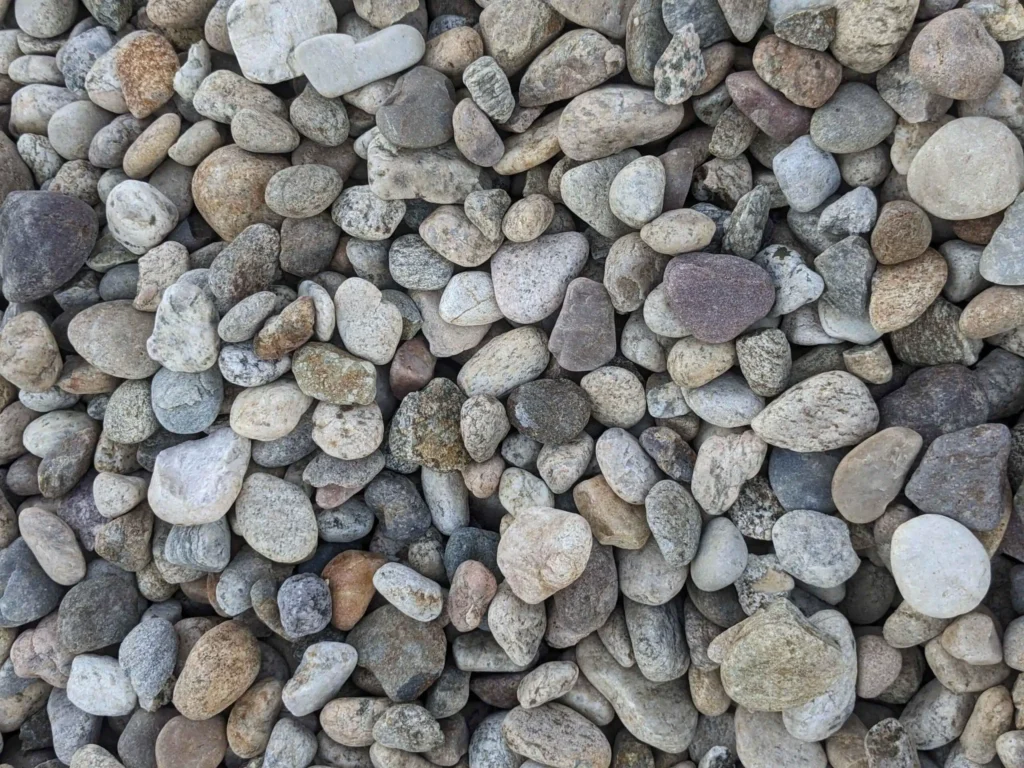 GUIDEThe Different Types of Gravel and How to ChooseA plain-language guide to the main types of gravel, covering pea gravel, crushed stone, river rock and decomposed granite.Read guide →
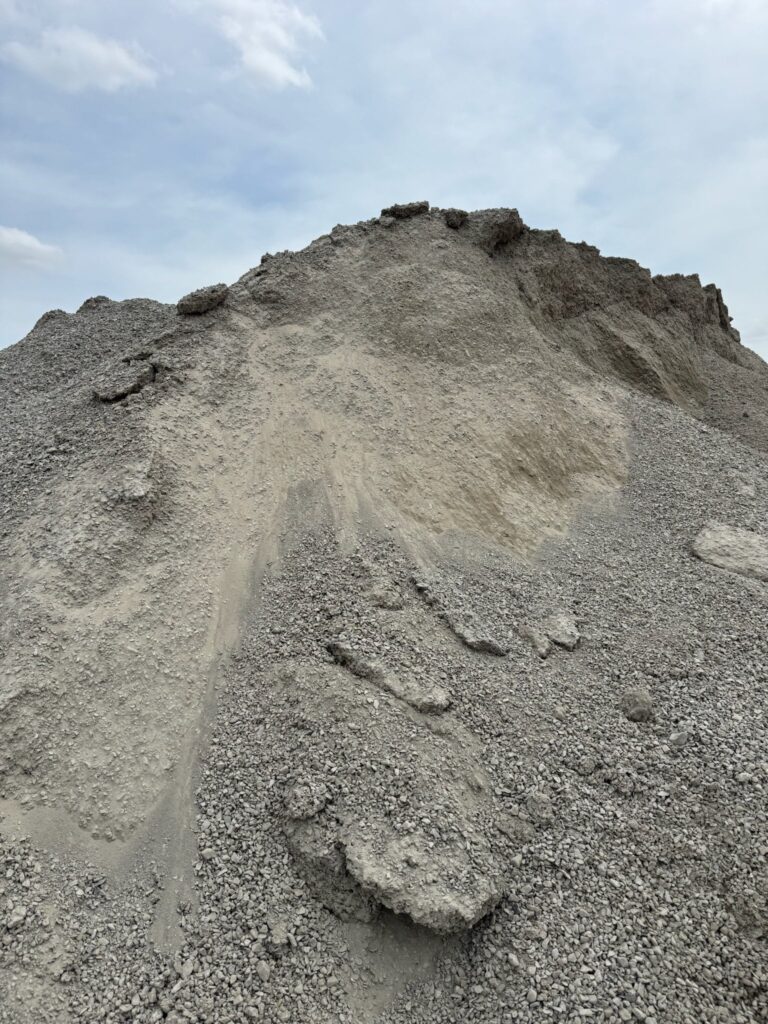 GUIDEWhat Are Screenings? A Guide to Crushed Stone FinesScreenings are fine crushed stone used for paver bases, joint fill and walkways. See what screenings are, common types, and mistakes to avoid.Read guide →GUIDEWhat to Put Under River Rock for Landscaping BedsHere is what to put under river rock landscaping: a compacted base where needed, then landscape fabric, then rock, to stop weeds and settling.Read guide →GUIDEHow to Clean River Rock and Restore Its ColorLearn how to clean river rock landscaping with rinsing, soap and vinegar methods, plus common mistakes to avoid for a brighter, longer lasting rock bed.Read guide →
Frequently Asked Questions
How much medium riprap do I need for a creek bank in Austin?
Plan on one ton covering about 35 to 40 square feet at the typical 12-inch placed depth. For a 450 square foot eroding bank that works out to roughly 11 to 13 tons, so rounding up to 16 tons both covers the slope and earns free delivery. Always order on the high side to fill voids and the toe trench.
How fast can you deliver riprap in Austin?
Smaller 1-ton orders usually arrive within 1 to 2 business days, while 6-ton loads often ship same or next day. Full 16-ton truckloads move on our free-delivery tier. Timing across the metro depends on access, so a clear driveway or staging pad speeds things up.
Do I need filter fabric under riprap in Austin's clay soils?
Yes, in almost every case. Austin's thin clay over limestone washes out fast, and riprap placed straight on bare soil fails as the fines erode from beneath it. Lay a geotextile filter fabric or a graded gravel filter against the prepared slope first. On creekside walls, a Drain Rock backing also relieves water pressure.
Will medium riprap hold up to Austin flash floods?
Yes, that is exactly what it is built for. Our hard, dense gray riprap resists the plucking and tumbling of high-velocity flow, and a well-graded 4 to 9 inch blend interlocks and fills its own voids. On creek work, key the toe in below the expected scour depth, since flood energy concentrates at the base of the bank.
Do I need a permit for creek riprap in Austin?
Often, yes. Work in or near a regulated creek channel or within the floodplain frequently triggers local floodplain and watershed review inside the city. Confirm requirements before placing stone in a waterway. We can deliver to your staging area while plans and approvals are finalized.
When is the best time to place riprap in Central Texas?
Summer dry spells are ideal because low creek and lake levels expose the toe and let crews key stone in properly. Spring is the peak flood and repair season, so book early if storm damage has hit. Mild Texas winters allow placement nearly year-round, with only the occasional cold snap slowing work.
Can I use riprap at a culvert or storm pipe outlet near Austin?
Yes, that is one of its core uses. A medium riprap apron breaks the energy of water leaving a pipe and prevents the scour hole that forms on the thin soil over rock here. Size the apron to the pipe and flow, extend it past where the water spreads and slows, and back it with a filter layer.
Should riprap be dumped or hand placed?
Place it, do not dump it. A dumped pile sheds stone in the first big storm, while placed stones interlock with the gaps filled by smaller pieces to form a stable blanket. On the steep limestone slopes west of Austin, a skid steer with a grapple does this far better than a loader bucket.
Do you deliver riprap outside Austin?
Yes. Our supply network runs along the I-35 corridor, so we reach Round Rock just up the highway, plus Killeen and San Antonio, with College Station and Waco on the same regional route. That keeps stone flowing into the metro, though the I-35 traffic crush means extra lead time helps during the spring rush.