
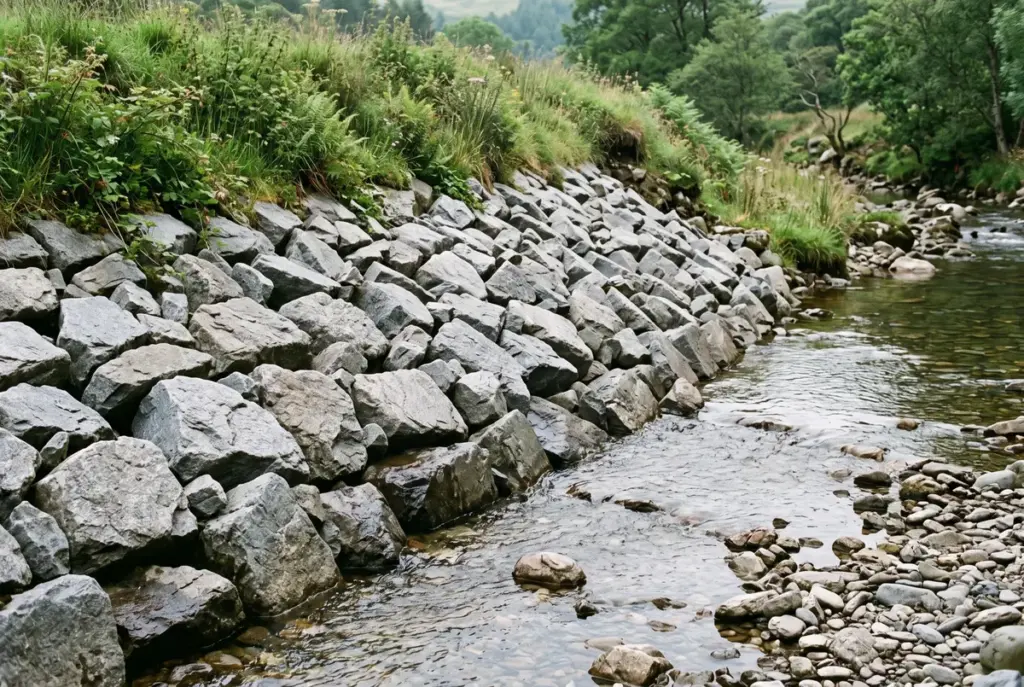
Riprap Med Delivery in Boston, MA
Bulk riprap med delivered in Boston, MA. Stone size 4 - 9. Gray color.
Riprap Med Delivery in Boston, Massachusetts
Boston is a coastal city built on filled tidal flats, glacial drumlins, and a tangle of rivers, harbors, and salt marshes. That setting makes water management a constant concern. Nor'easters drive storm surge and pounding wave action against shorelines from the Harbor islands to the South Shore, the Charles and Mystic Rivers swell with snowmelt and heavy rain, and the region's dense glacial till sheds runoff hard onto every slope and ditch line. Gray Riprap Med, our 4 to 9 inch graded armor stone, is the material New England crews trust to hold a shoreline or a bank against that kind of repeated assault. It is heavy enough to resist wave energy and high flow, sized to be placed by hand or small machine on tight urban lots, and angular so it locks into a durable armor blanket rather than washing apart.
Across the Boston-Cambridge-Newton MSA, Riprap Med starts . Coastal New England runs higher than inland markets, but because we operate our own trucks throughout Greater Boston you avoid the markups that come with sourcing armor stone in a dense, congested metro, with delivery to sites near downtown around 02108 or out into the surrounding suburbs.
Why Boston Crews Choose Riprap Med
The 4 to 9 inch grade is matched to the specific challenges of a cold, wet, coastal region. Around Greater Boston we deliver most often for:
- Shoreline and seawall protection along the Harbor, the South Shore, and tidal inlets, where wave action and storm surge erode unprotected banks.
- Riverbank stabilization on the Charles, Mystic, and Neponset, which run high during spring snowmelt and heavy coastal storms.
- Slope and embankment armoring on the steep drumlin lots and road cuts common across the metro's glacial terrain.
- Culvert and outfall protection, where concentrated discharge would otherwise scour the dense till and fill soils.
- Heavy drainage swales and detention basins handling the runoff that glacial till sheds rather than absorbs.
New England's freeze-thaw cycles and wave energy punish lighter materials. Plain Drain Rock works for subsurface seepage but washes out under surf or river flow, and loose boulders are hard to place evenly on a tight coastal lot. Riprap Med interlocks, dissipates wave and flow energy through its voids, and holds the bank soil in place behind it.
Local Delivery and Lead Times in Boston
We deliver Riprap Med throughout Greater Boston, including Cambridge, Newton, and the inner suburbs, with scheduled long-haul runs reaching toward New York and the eastern Pennsylvania markets of Scranton, Bethlehem, and Allentown on planned routes. For metro deliveries, small orders arrive in 1 to 2 business days, and at our mid tier we can often turn loads same or next day. Riprap is dense, so a tandem load tops out by weight, not volume. Boston's narrow streets, tight historic neighborhoods, and tidal access windows make site logistics important, so tell us about access, parking restrictions, and any tide-dependent shoreline work at order time so we route the right truck.
How Much Riprap Med Do You Need
Riprap Med is sold by the ton. At about 2,700 lbs per cubic yard, coverage is predictable once you set your thickness. For medium riprap, plan a placed layer 12 to 18 inches deep, roughly 1.5 times your largest stone, and a bit thicker where it faces direct wave action.
Here is a real Boston example. Say you are armoring an eroding section of tidal shoreline behind a South Shore property, treating a 50 foot run of bank that drops 9 feet down the face to the low-water line, for about 450 square feet at an 18 inch thickness given the wave exposure. That works out to roughly 27 to 30 tons of Riprap Med, including stone keyed in below the low-water mark. That volume puts you well into our top pricing tier.
Tiered Pricing for Boston
Pricing drops as your quantity climbs:
- 1 ton or more: with a $333 delivery fee, arriving in 1 to 2 business days.
- 6 tons or more: with a reduced $179 delivery fee, same or next day.
- 16 tons or more: with free delivery across the covered Boston area.
For the 27 to 30 ton shoreline job above, you clear the 16 ton tier easily and buy with no delivery charge. In a high-cost metro like Boston, hitting the free-delivery tier saves real money, so consolidating shoreline and drainage work into one order pays off quickly.
Installation and Spreading Tips
Base preparation is everything, and on Boston's till, fill, and saturated coastal soils it is non-negotiable. Lay a non-woven geotextile filter fabric on the prepared bank before placing stone. Without it, the fine soils pump out under wave and flow action and the armor sinks and fails. Key the toe in below the low-water or scour line, which on a tidal shoreline means working with the tide window, then build the face upward, setting the larger stones first and chinking the gaps with smaller pieces so the layer interlocks. Avoid simply end-dumping. Seating the stones with a bucket or by hand is what lets the armor survive a nor'easter. For culvert and outfall aprons, run the riprap at least three pipe diameters downstream and flare it to spread the energy.
Pairing With Other Materials
Boston jobs frequently layer materials. Crushed Concrete makes an economical, well-draining base for the access path or working pad above the shoreline, and a band of River Rock along the top of a finished bank gives a cleaner decorative transition where the armor meets a maintained yard. Where you only need to handle subsurface seepage rather than open water, a smaller Drain Rock trench may be all you need. Many coastal and riverfront sites use all three in one layered system.
Seasonal Notes for Massachusetts
New England's calendar shapes every shoreline and bank project. The harshest erosion comes from winter and early-spring nor'easters and from the spring snowmelt that swells the rivers, so the smart move is to place armor stone in late spring through fall, before that next winter season tests it. Frozen ground and snow cover make winter placement difficult, and saturated spring soils complicate keying the toe in. Demand for riprap surges after major coastal storms, which stretches lead times when everyone is repairing storm damage at once. Ordering ahead of winter locks in stone and lets you set it on firm, workable ground during the open season. Our trucks deliver year round, but for shoreline work the warmer, drier months give you the stable subgrade and the tide windows you need. Whether your project sits in the heart of Boston or out on the South Shore, placing your armor stone during the open season gives your erosion control the best chance to seat and hold before the first nor'easter of the year.
About Riprap Med
About Riprap Med (4 to 9 inch Armor Stone)
Riprap Med is a graded, angular armor stone running 4 to 9 inches across the largest dimension, supplied in a natural gray color. It is quarried and screened to a controlled gradation so the pieces interlock when placed, forming a stable, free-draining blanket that resists moving water. Unit weight runs about 2,700 lbs per cubic yard, which is why riprap is sold and priced by the ton rather than by volume.
This medium grade sits between fine drainage gravels and large boulder-class rock. The angular faces are important. Unlike rounded river stone, the broken faces of riprap lock against one another, so the layer behaves as a unit instead of rolling apart under flow or wave action. The open voids between stones let water pass through while the mass holds the soil beneath it in place.
Typical uses include streambank and shoreline stabilization, slope and embankment armoring, culvert and storm-pipe outlet protection, energy dissipation aprons, channel and ditch lining, detention-pond spillways, and bridge scour protection. It is also used as a heavy-duty base under retaining structures and as the working layer over filter fabric on erosion-prone sites.
is a drainage-category product and pairs naturally with Drain Rock, River Rock, and Crushed Concrete on layered erosion-control and site-prep jobs.
What Riprap Med costs in Boston
Around Boston, riprap med is quoted by the ton with delivery layered in based on distance from the closest yard. Send your ZIP and load size and we will send back a same-hour quote with the truck rate and the per-ton figure spelled out. Plan on roughly 80 sq ft of coverage per ton at 3 inches deep, which puts a single-car driveway in the 4 to 8 ton bracket.
How crews use Riprap Med in Boston
Boston contractors keep riprap med on the order sheet for a short list of standard installs. Top of the list is erosion control, where the material is rolled out in tight urban lots and infill builds and screeded to grade. Right behind that is drainage gravel, common in dense neighborhoods where curb access is short and often paired with edging or fabric below the lift. Boston sits at about 654,776 residents, which means we see steady weekday traffic from landscape crews and weekend pickups from owner-builders.
Delivery day in Boston
Delivery in Boston runs out of the nearest pit; you get a two hour arrival window the evening prior and a call when the driver leaves the scale. Plan for 12 ft of clear path for a tandem and 14 ft for a tri-axle, plus a level area at the dump point so the bed lifts straight. Standard lead time on this lane is Mon-Sat, with same-day windows held open for orders that hit the desk before 11 AM and clear payment.
Related materials we deliver in Boston
Estimate how much you need
Calculate Your Project
Estimate only. Add 10-15% for compaction and waste.
Browse more
Common uses for Riprap Med in Boston
Available in nearby cities
Plan your project
Related guides
 GUIDEHow to Lay a Gravel Driveway: Step-by-Step GuidePractical, field-tested guide: how to lay gravel driveway. Pulled from real US installer notes and 2026 supplier price data.Read guide →
 GUIDEDoes Gravel Stop Weeds? Honest Answer + What WorksPractical, field-tested guide: does gravel stop weeds. Pulled from real US installer notes and 2026 supplier price data.Read guide →
 GUIDEHow Much Gravel Do I Need? Quick Sizing GuidePractical, field-tested guide: how much gravel do i need. Pulled from real US installer notes and 2026 supplier price data.Read guide →
 GUIDEWhat Is #57 Stone? Uses, Size, and Cost ExplainedPractical, field-tested guide: what is 57 stone. Pulled from real US installer notes and 2026 supplier price data.Read guide →
Frequently Asked Questions
How much Riprap Med do I need for a shoreline in Boston?
Measure the bank area in square feet and plan a placed layer 12 to 18 inches thick, on the thicker end where it faces direct wave action. As a guide, a 50 foot shoreline covering about 450 square feet at 18 inches takes roughly 27 to 30 tons. Add extra keyed in below the low-water line.
How fast can you deliver Riprap Med to Greater Boston?
Small and single-ton orders arrive in 1 to 2 business days. Orders of 6 tons or more often ship same or next day across Greater Boston, including Cambridge and Newton. Tell us about narrow streets, parking limits, or tide windows so we route the right truck.
Why is Riprap Med sold by the ton in Boston?
The stone weighs about 2,700 lbs per cubic yard, so weight is the limiting factor on a truckload and the fairest way to price it. Buying by the ton means you pay for the actual mass of armor stone delivered to your site.
Do I need filter fabric under riprap on Boston coastal soils?
Yes, it is essential. Boston's till, fill, and saturated coastal soils pump fines out under wave and flow action, so a non-woven geotextile filter fabric under the stone keeps the armor from sinking and failing. The fabric holds the soil while letting water drain through.
Will Riprap Med hold up to a nor'easter?
The 4 to 9 inch gradation is sized to resist the wave energy and storm surge that nor'easters drive against New England shorelines. For severe open-coast wave exposure a heavier class may be specified, so describe your wave and flow conditions when you order.
Can I do tidal shoreline work with Riprap Med?
Yes, but tidal work requires planning around the low-water window so you can key the toe in below the low-water line. Coordinate delivery and placement with the tide schedule, and tell us at order time so we route the truck to match your access and timing.
When should I install riprap in Massachusetts?
Late spring through fall is best, before winter and early-spring nor'easters and after the snowmelt-swollen rivers recede. Frozen and saturated ground make placement hard. Order ahead of winter to lock in stone and set it on firm, workable ground during the open season.
What other materials pair with Riprap Med on a Boston job?
Crushed Concrete makes an economical, well-draining base or access pad above a shoreline, River Rock gives a clean decorative band where the armor meets a yard, and Drain Rock handles subsurface seepage in trenches. Many coastal and riverfront sites layer these together.